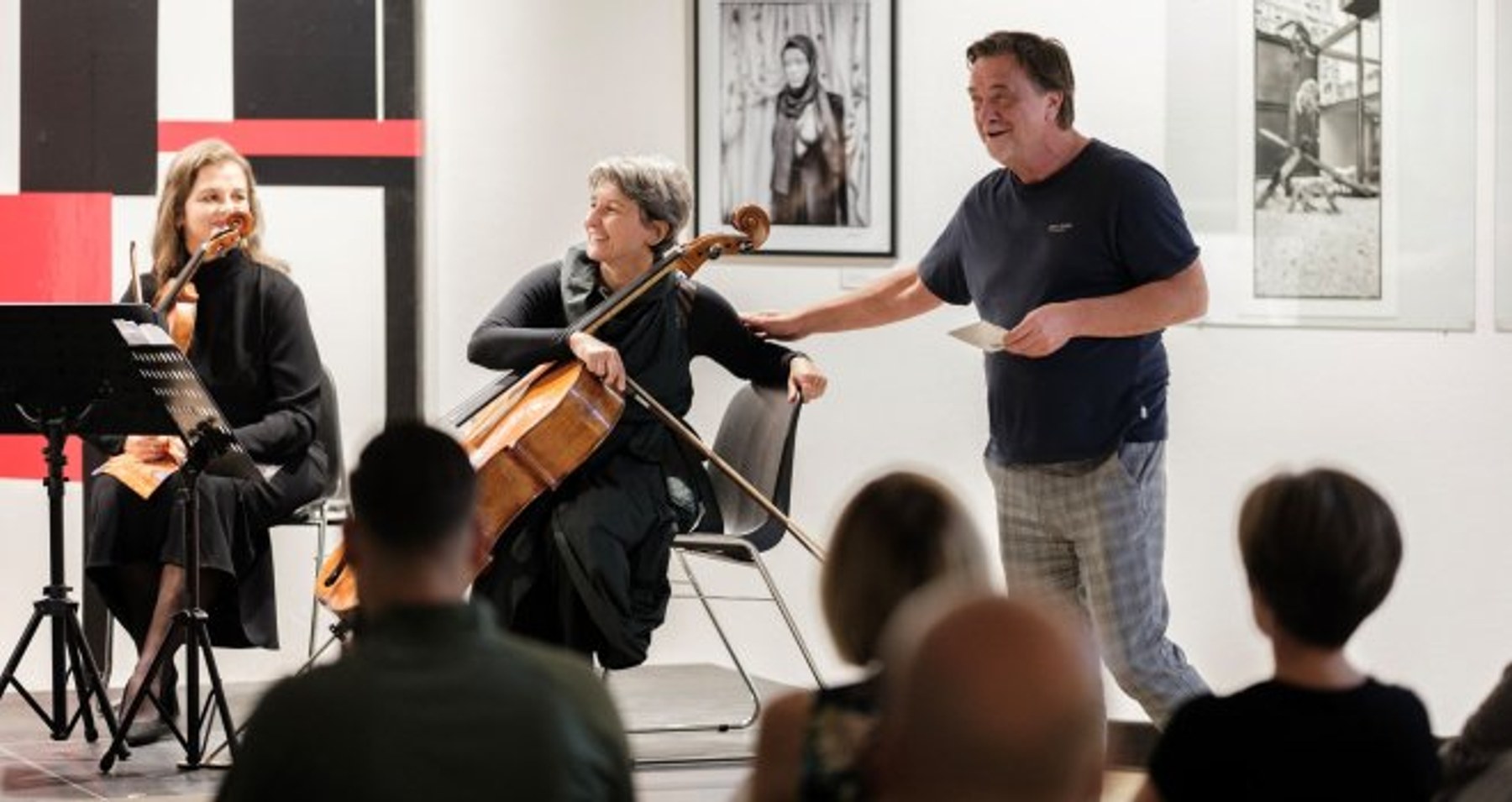
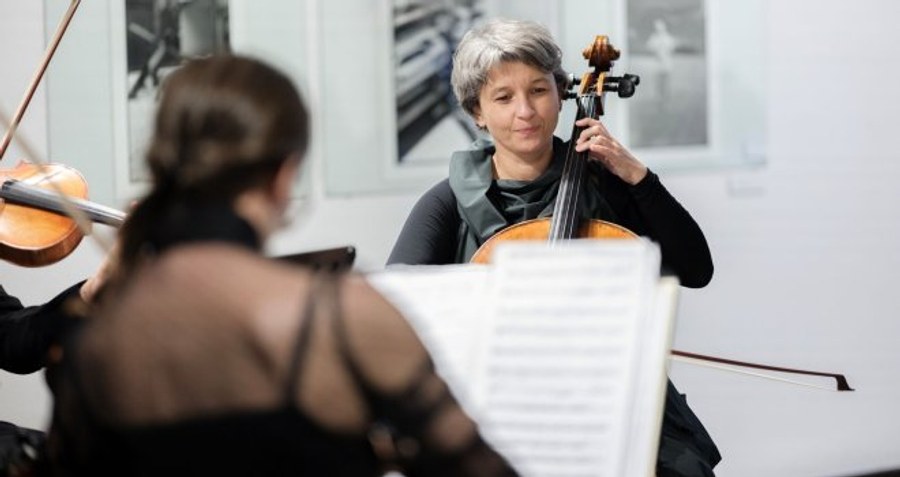
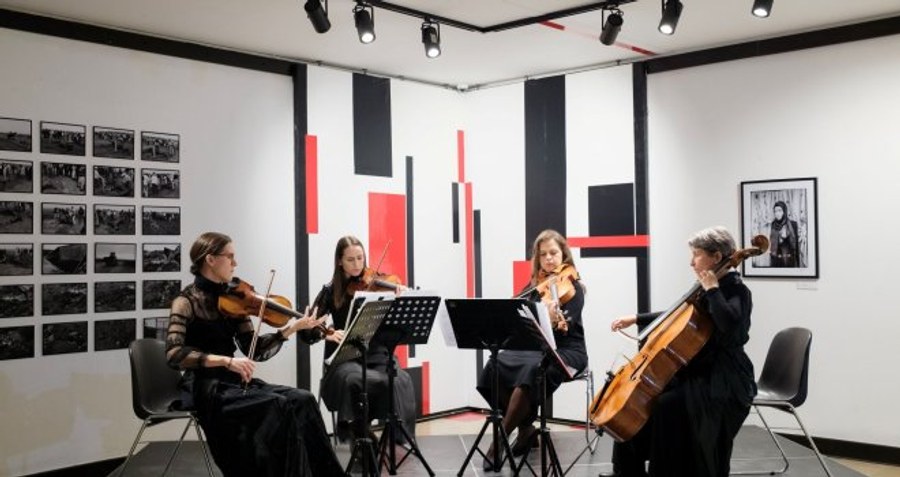
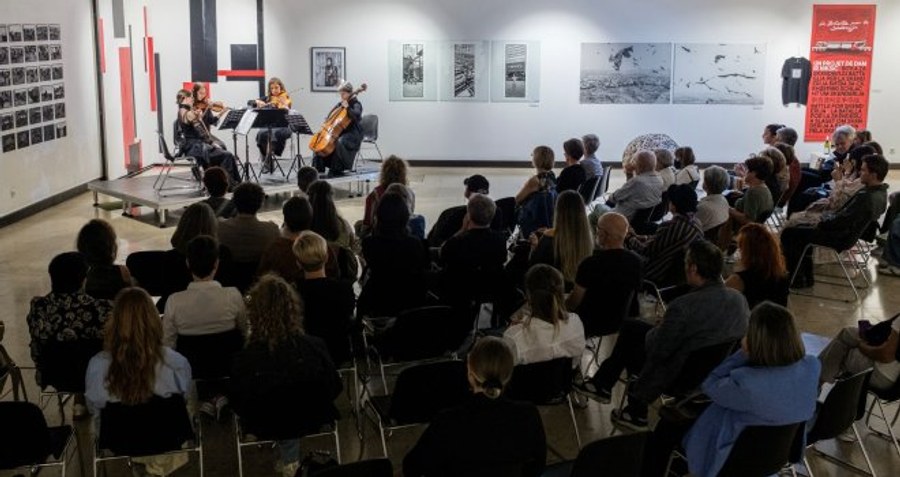
The ensemble translated the scope and diversity of the exhibition into a musical trajectory ranging from Baroque imagination and early Modernism to contemporary improvisations. The program featured compositions by Heinrich Ignaz Franz Biber, Ališer Sijarić, Johann Sebastian Bach, Ludwig van Beethoven, Pēteris Vasks, Claude Debussy, Franz Schubert, Dmitri Shostakovich, Vlado Milošević, and Josip Hatze, creating a series of sonic "commentaries" on the works within the exhibition.
The evening opened with Biber’s „Battalia à 10“, whose dramatic energy—from soldierly outcries to a lament for the fallen—articulates internal conflict. In contrast to this style, Sijarić’s „True Believer“ was heard; a contemporary piece for string orchestra that uses filtration techniques and micro-structures to decompose sound into its deepest layers. While „Battalia“ builds a macro-narrative of conflict and rebellion, Sijarić introduces an introspective layer—an obsession with source material from which a fragmented yet intense sonic matrix emerges.
As a third layer, Nikšić’s „The Battle for Skenderija“ resonated—a visual work that reinterprets Sarajevo's urban myths through performance, photography, and intervention. In dialogue with Biber’s sounds and Sijarić’s micro-sonic decompositions, Nikšić’s work receives a musical meta-reading: the Baroque conflict becomes a stylistic framework for confronting collective memory and the tensions of urban identity.
From the exhibition's background, Almin Zrno's photograph „Per aspera ad astra“ stood out, its fragment of the sky becoming a visual counterpart to Bach’s aria „Es ist vollbracht“ from the St. John Passion. Baroque piety and architectural harmony—what Wagner called "the most wonderful miracle of all music"—find in Bach’s sound the same tense balance between suffering and ascension that Zrno captures in his motif of the journey "through thorns to the stars."
Halil Tikveša's provocative work „Religion Kills“ prompted the performers to shape a musical response rooted in four religious traditions—Catholic, Orthodox, Jewish, and Islamic—culminating in Beethoven’s Allegretto from the Seventh Symphony, which in this context was transformed into a funeral march. In the final chord, the silence of death remains as an inexorable metaphor for the abuse of faith and human negligence.
The visual work "Rhythm and Color" by Jai Kwan Kim found a subtle resonance in the meditative score of Pēteris Vasks’ "Castillo Interior." Its sonic simplicity and universally understandable musical language, driven by a yearning for harmony between man and nature, underscore the same inner balance and discipline that Kim develops through the play of color and rhythmic structures.
In a rarely performed work by Vlado Milošević for quartet and narrator, the verses of Mak Dizdar from Stone Sleeper came to life within a powerful musical dramaturgy. Meanwhile, Emir Kapetanović’s "Record of Injustice" expanded this meaning toward a contemporary witnessing of transience and social inequity—here, the sonic and visual layers together become both a warning and a memorial.
Dženat Dreković’s photograph "Wild is the Wind," in which the wind suddenly reveals the hijab of a mannequin in a shop window, provokes questions about the boundaries between the private and public, the intentional and the accidental. This visual tension alludes to Debussy’s remark that "music must be free from all learned bombast" and to Bowie’s stripped-back interpretation of the song "Wild Is the Wind"—a space of vulnerability and longing that eludes simple interpretation.
In the concert's finale, photographs by Milomir Kovačević Strašni from the cycle "They Shoot Horses, Don't They?" found a musical echo in Schubert’s String Quartet in D minor, "Death and the Maiden." The scene of a village party in Mexico, where a horse race turns into a silent witness to suffering, is linked by the author to his own wartime experience—devoid of images of blood, yet carrying the same sense of tragic necessity. Schubert, who himself recorded hopelessness and the premonition of the end, builds an elegy in this quartet where fear and serenity meet on the thin line between life and death.
This thread was continued by Shostakovich’s String Quartet No. 8 in C minor (Largo) in its encounter with Šejla Kamerić’s "Bosnian Girl." The graffiti of an unknown Dutch soldier, transferred to the walls of the factory in Potočari, exposes prejudice and indifference in the face of the Srebrenica genocide. Kamerić emphasizes that "Bosnian Girl" is not an individual figure but a universal symbol of bodies deprived of rights. Shostakovich’s quartet, "written with an immeasurable number of tears," as the composer himself described it, becomes the sonic counterpart to this work—music that, in its slow, almost liturgical movement, transforms grief, suppressed pain, and moral condemnation into an indelible testimony.
The first concert of the third "Music Through the Exhibition" cycle demonstrated how music, liberated from a decorative role, can function as an analytical and interpretive layer of visual art, expanding its context and offering new readings of the exhibited works. The "SubDocumenta Sarajevo '25" exhibition is open until September 30, 2025, and the next concert within the project will be held at the National Gallery of Bosnia and Herzegovina.
The "Music Through the Exhibition" project is realized with the support of the City of Sarajevo, the Ministry of Culture and Sports of Sarajevo Canton, the Federal Ministry of Environment and Tourism, and in collaboration with Collegium Artisticum.