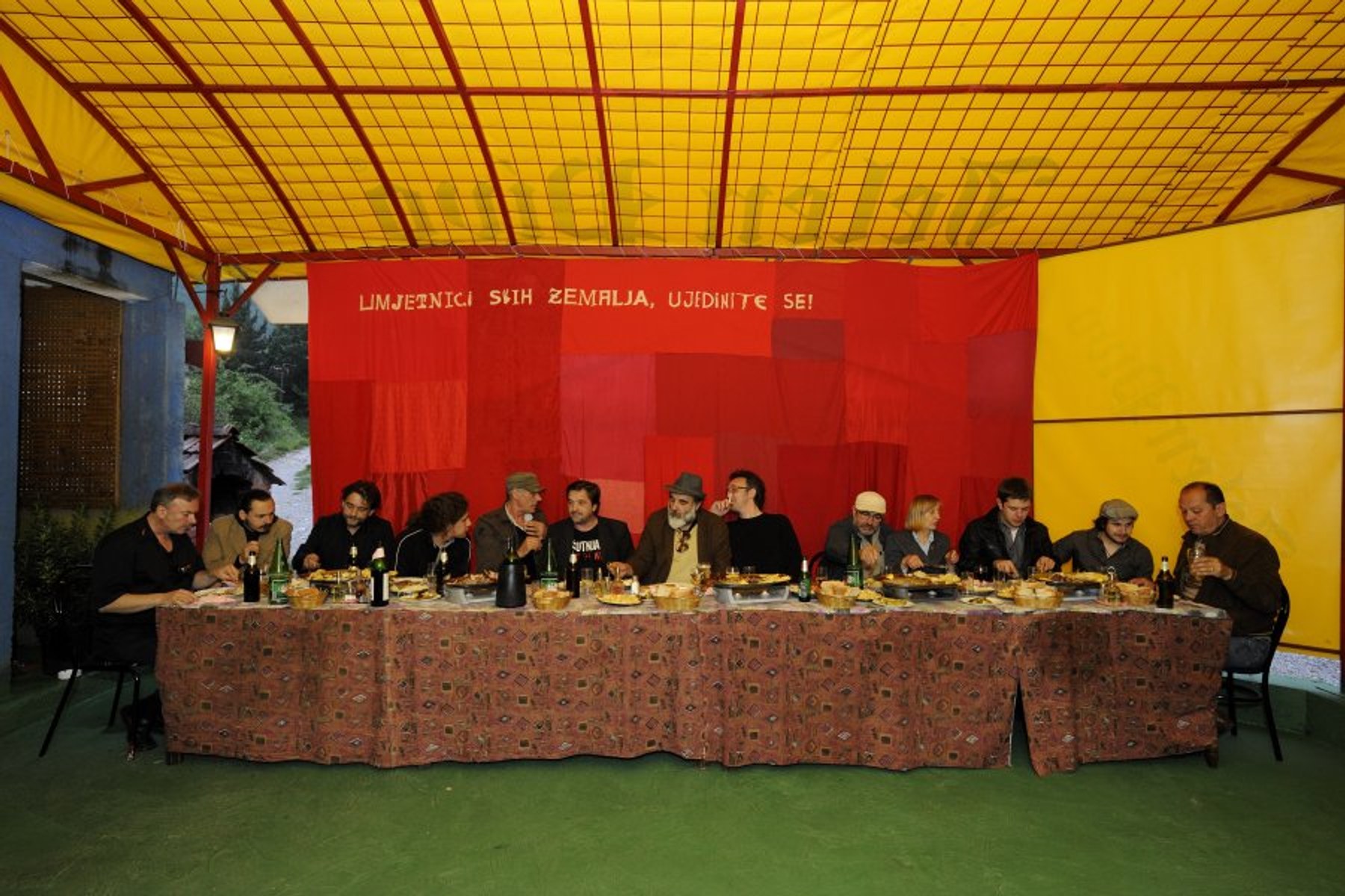
On June 27, 2010, in the restaurant “As” in East Sarajevo, artist Jusuf Hadžifejzović staged the performance “The Last Supper”, continuing his long-standing exploration of universal truths and the relationship between art and life. The event was part of a broader series of artistic activities by the Center for Cultural Activities Charlama, marking a continuation of Sarajevo’s vibrant art scene of the 1980s and its vision of reviving the contemporary art biennale.
The dinner began with a minute of silence in honor of recently deceased conceptual artist Tomislav Gotovac. Artist Kata Mijatović, one of the participants, emphasized her appreciation of the work, noting how moving it was that Hadžifejzović partly dedicated the performance to Gotovac.
The aim of the performance was to gather artists from across the region and encourage intergenerational exchange. Seated under the slogan “Artists of the world, unite”, alongside Hadžifejzović were Aleksandar Bukvić, Boris Šiber, Jasmin Duraković, Zoran Kusmuk and members of the group “Pleh”, as well as younger artists Marko Kusmuk, Emir Mutevelić, Dženan Hadžihasanović and Đorđe Krajišnik.
The performance “The Last Supper” was first staged in Pula in 1979, and later presented to the Bosnian public in 1984 at the Amphitheatre Theatre in Sarajevo’s Dom mladih. A key role in shaping the overall artistic concept was played by Aleksandar Bukvić.
Curator Branka Vujanović highlights that Hadžifejzović’s work continuously blurs the line between art and life—especially when the artist places himself or his family in real and symbolic risk, or when the artistic act becomes a “secret” gathering of fellow artists. In such cases, it becomes difficult to determine where art ends and real life begins, as the artist himself becomes part of his own assemblage or installation.
“I am proud to have been a guest at ‘The Last Supper’. I also attended the performance in Skenderija together with Jusuf and Saša Bukvić. It is a great honor to share this space with such people and to express our views together,” said Boris Šiber in a DEPO TV video report.
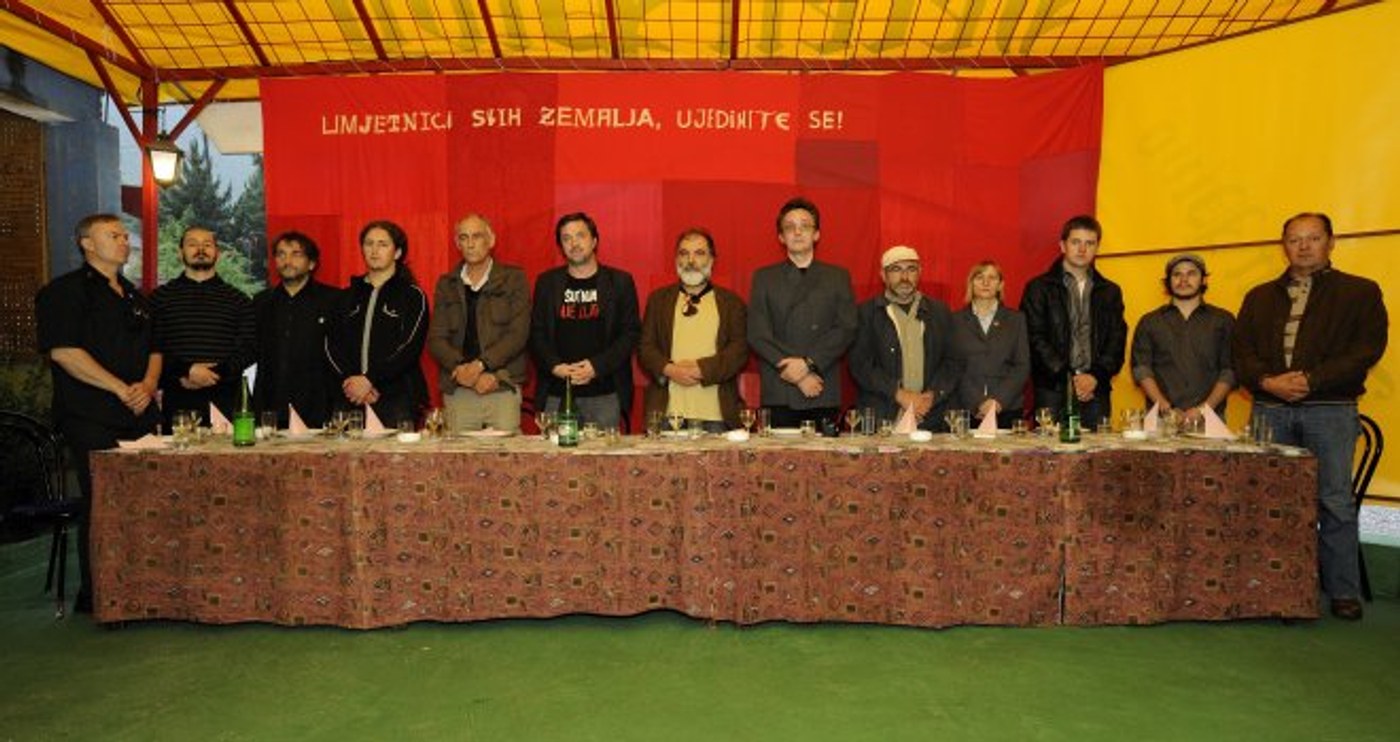
The artwork “Red Flag” by Robert Sošić, under which the artists were seated, was composed of small pieces of fabric contributed by 30 artists who remained outside institutional systems. The idea that everyone profits from art except the artists themselves inspired the slogan “Artists of the world, unite.”
Following the performance, “Red Flag” traveled to Zagreb with members of the “Pleh” group—Marijan Molnar, Kata Mijatović, Vlatko Vincek and Zoran Pavelić—who had opened an exhibition within the SubDokumenta project. This initiative continues the legacy of the YU Dokumenta exhibitions, which emerged in Sarajevo’s art scene in the 1980s, evolving from a series of smaller exhibitions into major biennials held in Skenderija in 1987 and 1989.
“I am glad that we are in East Sarajevo and that such an event is taking place here, bringing together artists from Zagreb, Sarajevo and East Sarajevo—because art knows no borders,” said Jasmin Duraković.
The 2010 performance “The Last Supper” represented a rare moment of artistic clarity in the often challenging cultural reality of Bosnia and Herzegovina. Through a powerful symbolic gesture, Hadžifejzović offered an aesthetic reflection of social and political reality, demonstrating how boundaries can be broken and how art can assume an avant-garde role. At the same time, the performance carried a strong anti-capitalist message, questioning the relationship between art and life while constructing a complex system of symbols that reflect contemporary society.
“The Last Supper in East Sarajevo” stands today as a hybrid individual-collective artwork that transcends its time, and is increasingly the subject of research by prominent art historians in the region and beyond.
By Vanja Šunjić